ISO 9001 & 14001 · LFGB §30/§31 [email protected] FOB New Mangalore Port, India
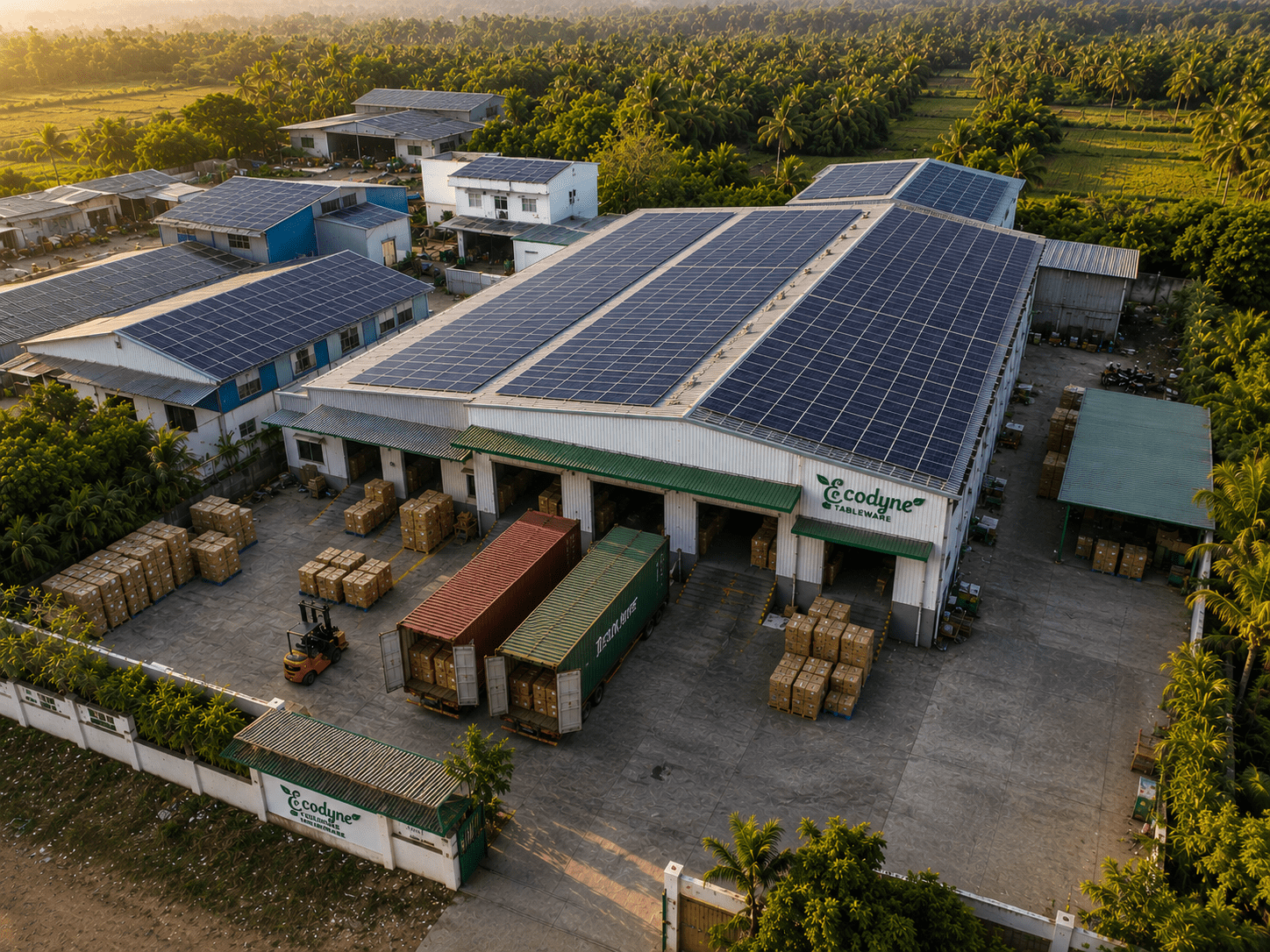
Aerial view of the Ecodyne Tableware palm leaf plate factory in Karnataka, India, with rooftop solar array and export containers at the loading dock

India’s Largest Palm Leaf Tableware Factory

Palm Leaf Plates Manufacturer & Exporter

4.5 million areca leaf plates, bowls and trays every month — pressed from naturally fallen sheaths, with no chemicals, dyes or binders.
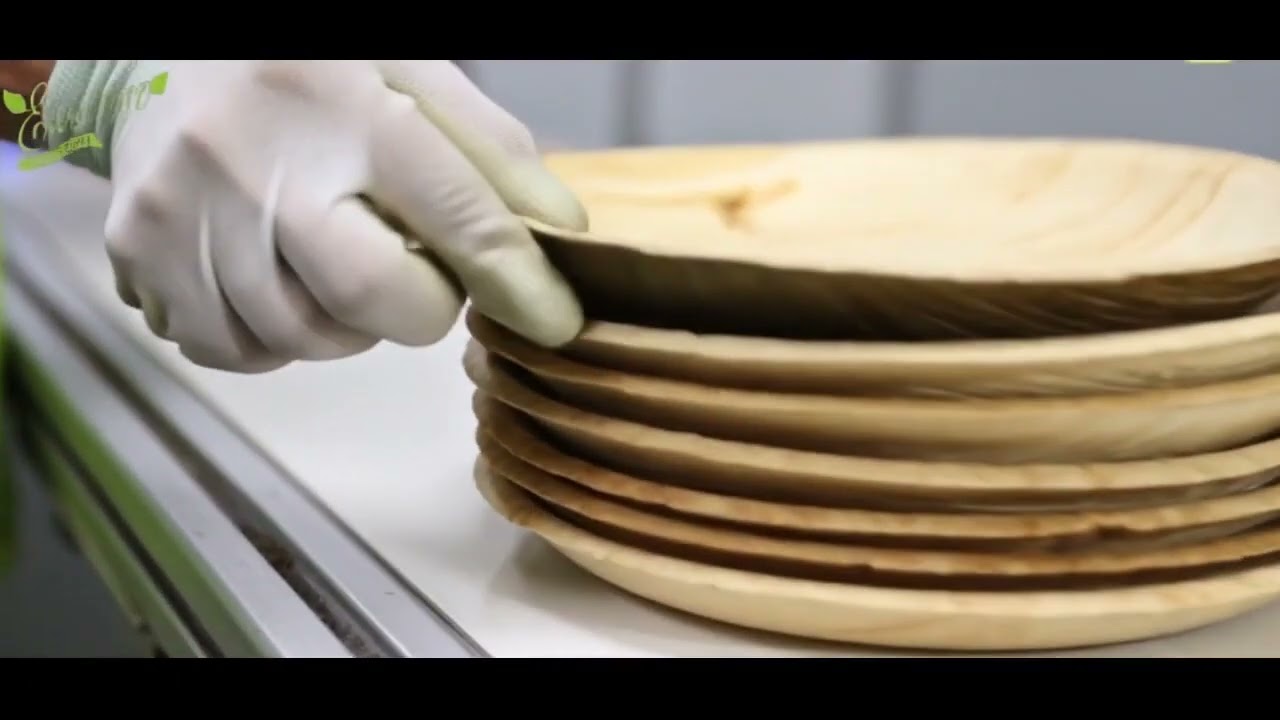
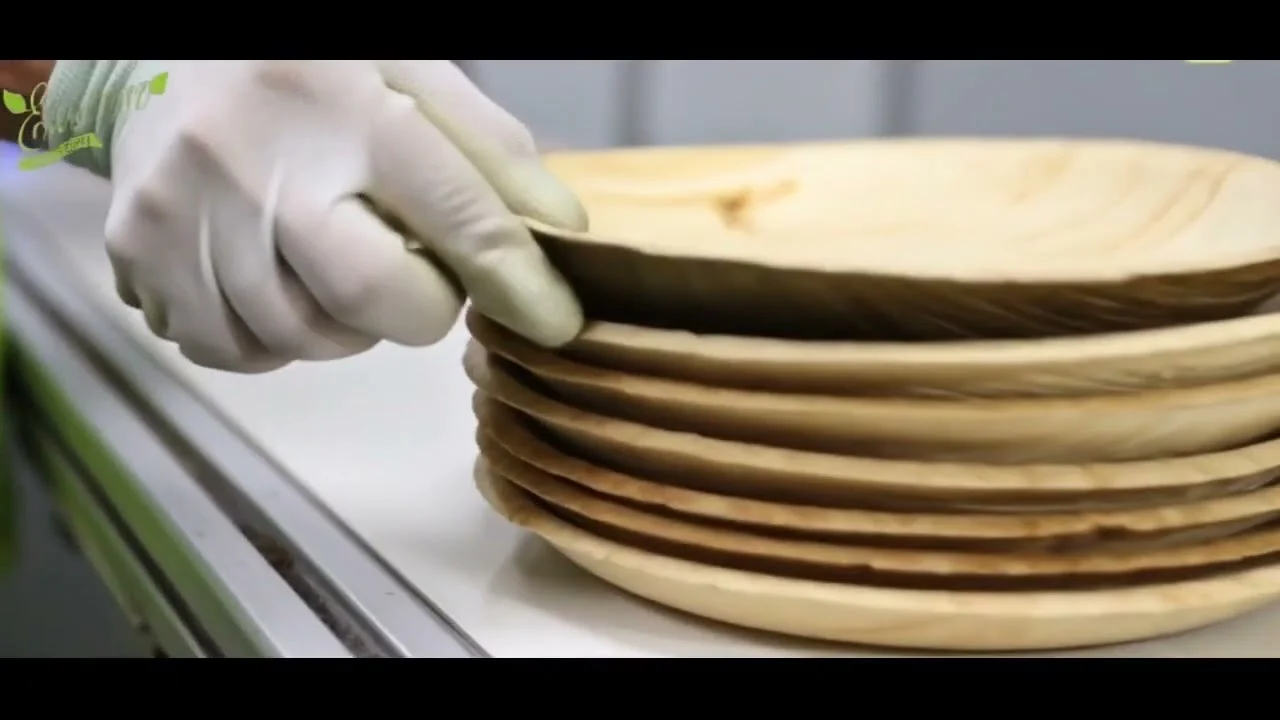
Heat pressing areca palm leaf sheaths into plates at 200°C in CNC hydraulic moulds

Eight-Stage Heat-Pressed Process

One Fallen Sheath. One Plate. Zero Additives.

Washed, soaked, pressed at 200°C, dried 24 hours, UV sterilised and hand-inspected — every single piece.
Export cartons of compostable palm leaf dinnerware palletised for FCL shipment from New Mangalore Port

FCL Export · 19 Countries

Container Loaded in 10 Days

One 40ft high-cube MOQ, mixed sizes at no extra charge, FOB New Mangalore — backed by a 1%-per-day delay penalty in your favour.

4.5MUnits per month
90Production units
10 daysOrder to container
19Export markets
15+ yrsDirect manufacturer-exporter

Who You Are Buying From

A Factory, Not a Trading House

Ecodyne Tableware, a brand of Conservia Partners, is India’s largest manufacturer and exporter of areca palm leaf tableware. Head office in Manjeshwar, Kerala; production in Bhadravathi, Shivamogga district, Karnataka — the heart of India’s areca belt.

We sell only to importers, distributors, foodservice wholesalers and private-label brand owners, by the full container. No retail, no drop-ship, no re-sold third-party stock: every plate shipped under a customer’s label is pressed in our own moulds, inspected by our own QC line and loaded under our own export documentation.

  • Raw material: only sheaths the areca palm sheds naturally — no tree is ever cut.
  • Supply base: ~810 partner farming families across four Karnataka districts, guided by a 7-year CPCRI (ICAR) programme.
  • Energy: the main production facility runs fully on rooftop solar photovoltaics.
  • Team: 262 employees; amfori BSCI-audited social compliance.
Overhead view of Ecodyne Tableware's solar-powered areca leaf plate manufacturing facility in Karnataka with containers being loaded for export
Ecodyne’s Karnataka facility: rooftop solar array, two 40ft high-cube containers under load, and palletised export cartons — surrounded by the areca groves that supply the sheaths.

Product Range

Compostable Palm Leaf Dinnerware, Built for Export Shelves

Round plates 4″–12″, square plates 6″–10″, bowls, platters, trays and compartment plates. Every SKU available in Premium, Economy and Domestic grades, with retail-ready or bulk catering packing.

Palm Leaf Plates

Round and square heat-pressed areca sheath plates — the core SKU for caterers, party retail and meal-kit brands.

  • Round 4″ to 12″
  • Square 6″ to 10″
  • Oven safe to 200°C · freezer safe
View plates →

Palm Leaf Bowls

Deep-pressed bowls for soups, salads, curries and açaí-style concepts, with reliable rim strength for hot fills.

  • 4″ to 8″ diameters
  • Multiple depths / volumes
  • Leak-resistant, no lining
View bowls →

Platters & Trays

Large-format serving platters and catering trays for hospitality, buffets, grazing boards and event supply.

  • Rectangular & oval formats
  • Banquet and buffet sizes
  • Rigid, stack-stable in cartons
View platters →

Compartment Plates

Two-, three- and five-compartment trays for portioned meals, school catering, airlines and thali service.

  • 2, 3 & 5 section layouts
  • Custom mould development
  • Ideal for meal programmes
View compartment plates →

Verified & Documented

Three Claims We Will Put in Writing

Capacity, compliance and raw-material security are the three things that decide whether a palm leaf supplier survives your first season. Each is published here in summary and released in full as a documentation dossier to qualified buyers.

Verified · Production records

4.5M units/month, scalable to 9M

Ninety manufacturing units deliver 4.5 million palm leaf units per month today, with documented scale-up to 9 million within 75 days against a confirmed annual programme, achieved through additional shifts rather than new plant.

Source: internal capacity & despatch records (released on qualification)

Production capacity →
Verified · Third-party audit

ISO, BSCI, LFGB, USDA, EN 13432

ISO 9001:2015 and ISO 14001:2015 (TÜV India), amfori BSCI social audit, LFGB §30/§31 food-contact testing for the German market, USDA BioPreferred, EU Regulation 1935/2004 compliance and EN 13432 compostability — tested PASS.

Source: certificate scans & laboratory reports

Certifications →
Verified · CPCRI programme

~810 farming families, 7-year partnership

Sheath collection is organised with roughly 810 farming families across four Karnataka districts under a programme guided by the Central Plantation Crops Research Institute (CPCRI / ICAR): 2,000 ha certified organic, 4,500 ha in conversion.

Source: CPCRI programme agreement & grower registers

Sustainability →

Inside the Plant

How Areca Leaf Plates Are Made — Eight Stages

Filmed at our Bhadravathi manufacturing base in Shivamogga district, Karnataka: from the plantation floor to palletised export cartons.

Video: Ecodyne Tableware's eight-stage areca leaf plate manufacturing process in India

Some shots were reconstructed from frames of our own factory footage using AI video tools. The process, the facility and the figures are our own.

  1. Collection

    Naturally shed sheaths are gathered from the plantation floor by partner farming families. No tree is cut.

  2. Grading

    Each sheath is checked for size, thickness and surface quality before it enters the line.

  3. Washing

    Hydro-pressure washing removes sand, grit and field debris.

  4. Soaking

    Sheaths are soaked until pliable enough to take a mould without cracking.

  5. Heat pressing

    Pressed at 200°C in CNC hydraulic moulds — heat and pressure only, no binders.

  6. Drying

    24 hours at 60°C to stabilise moisture content for ocean transit.

  7. UV sterilisation

    A second sterilisation step on the conveyor, after the heat press.

  8. Inspection & packing

    100% hand inspection; 15–17% rejected. The rest are graded, cartoned, sealed and palletised.

For Importers & Brand Owners

Two Ways to Buy From the Factory

Wholesale · Full Container Supply

MOQ is one 40ft high-cube container — roughly 67 m³ floor-loaded, or 300,000–350,000 pieces. Mixed SKUs are accepted inside the same container at no extra charge, so a first shipment can test several sizes in your market at once.

  • Incoterm: FOB New Mangalore Port, India
  • Lead time: 10 days, order to loading
  • Price validity: fixed for up to 24 months
  • Protection: 1%-per-day delay penalty in the buyer’s favour

Private Label · OEM Manufacturing

We currently press palm leaf tableware for 32 white-label brands in 19 markets. Scope covers artwork adaptation, shelf-ready carton design, barcodes, multilingual compliance text, dedicated SKU codes and master-carton labelling.

  • OEM MOQ: one 40ft container per SKU mix
  • Custom moulds: available for exclusive shapes
  • Documentation: LFGB, ISO, USDA packs for your file
  • Exclusivity: territory terms on annual programmes

Trust & Compliance

Audited, Tested, Import-Ready

Food-contact and social-compliance documentation is the first thing European and North American buyers request at customs. Ours is already on file.

ISO 9001:2015Quality management · TÜV India
ISO 14001:2015Environmental management · TÜV India
LFGB §30/§31German food-contact parameters
EU 1935/2004Food contact materials compliance
USDA BioPreferredBio-based product programme
amfori BSCISocial compliance audit

Reference & authority sources

  • TÜV IndiaCertification body for ISO 9001:2015 and ISO 14001:2015
  • amfori BSCISocial compliance audit framework for the supply chain
  • CPCRI / ICARCentral Plantation Crops Research Institute — scientific partner on areca cultivation
  • LFGB §30 / §31German Food and Feed Code — food-contact safety parameters
  • USDA BioPreferredUnited States Department of Agriculture bio-based programme
  • EN 13432European compostability standard — tested PASS

Global Reach

Shipping to 19 Countries Across Four Continents

Current cadence is roughly three 40ft high-cube containers per month (about 36 containers a year), with a pre-pandemic peak near five per month. All shipments leave FOB New Mangalore Port with full export documentation, phytosanitary paperwork and container photographs supplied before sailing.

Germany flagGermany France flagFrance Spain flagSpain Italy flagItaly Netherlands flagNetherlands United Kingdom flagUnited Kingdom Denmark flagDenmark Sweden flagSweden Norway flagNorway Finland flagFinland Greece flagGreece Israel flagIsrael UAE flagUAE United States flagUSA Canada flagCanada Australia flagAustralia New Zealand flagNew Zealand

Export Countries
Ecodyne perspective

We built Ecodyne as the operating system of the palm leaf industry, not a single-product brand. That means publishing what we would otherwise be asked to prove: capacity records, solar registration, certificate dossiers, the CPCRI farming programme. Lead-time honesty is the foundation of a continuous export record across 19 countries — which is why our contracts carry a delay penalty written in the buyer’s favour.

— Vinay Manjeshwar, Managing Partner, Conservia Partners

Buyer FAQ

Sourcing Questions, Answered Plainly

One 40-foot high-cube container. Floor-loaded, a 40ft HC takes roughly 67 m³ — about 300,000 to 350,000 pieces. Mixed SKU configurations are accepted at no extra charge, so a first container can carry round plates, square plates, bowls and trays together. Pricing is FOB New Mangalore Port, India.
Ten days from confirmed order to loading at New Mangalore Port. Standard supply contracts include a 1%-per-day delay penalty written in favour of the buyer, and enquiries receive a response in under four business hours, Monday to Saturday IST.
ISO 9001:2015 and ISO 14001:2015 (TÜV India), amfori BSCI social compliance, LFGB §30 and §31 parameters tested for the German market, USDA BioPreferred, compliance with EU Regulation 1935/2004 on food contact materials, and EN 13432 compostability testing with a PASS result.
No. Each plate is pressed from a single naturally fallen areca sheath using heat and pressure only — 200°C in CNC hydraulic moulds. No chemicals, dyes, binders, waxes or laminates are used at any stage, which is exactly why the finished product composts in commercial and home conditions and carries no lining to separate.
Yes — we currently produce for 32 white-label brands across 19 export markets. Private label scope covers artwork adaptation, packaging design, retail-ready shelf cartons, barcoding, dedicated SKU codes and master carton labelling. OEM minimum order is one 40-foot container per SKU mix.
Installed capacity is 4.5 million units per month, with documented scalability to 9 million units per month within 75 days against a confirmed annual programme. Raw-material security comes from roughly 810 partner farming families covering 2,000 hectares of certified-organic areca cultivation, with a further 4,500 hectares in organic conversion.
Heat-pressed areca sheath is rigid, oil-resistant and microwave- and oven-safe to around 200°C for short periods; it is also freezer-safe. Because each sheath is unique, natural grain variation and shade differences are inherent to the product, not defects — an important point to brief your retail buyers and end customers on.
Confirm your destination’s single-use plastics rules, food-contact declaration requirements, compostability labelling claims and import duty class for bio-based tableware. We supply the technical file — LFGB, ISO, USDA BioPreferred and EN 13432 reports — so your customs broker and retail compliance team can file without delay.

Work With the Factory Direct

Plan Your First Container

Tell us your market, target sizes and annual volume. Our export desk replies within four business hours with specifications, carton data and container loading plans.