ISO 9001 & 14001 · LFGB §30/§31 [email protected] FOB New Mangalore Port, India
Ecodyne palm leaf plate manufacturing facility in Karnataka, India

Industrial Scale · 4.5M Monthly Output

Palm Leaf Plate Manufacturing — Karnataka, India

Explore Ecodyne's solar-powered manufacturing infrastructure, 8-stage heat-pressed production process, and zero-chemical quality assurance engineered for international volume buyers.

4.5MMonthly Capacity
200,000 sq ftConsolidated Facility
200°CCNC Hydraulic Press
100%Solar-Powered Units
90%Reclaimed RO Water

Production Infrastructure

Industrial Capacity Built for International Supply Chains

Ecodyne Tableware operates a 200,000 sq ft consolidated manufacturing plant in Shivamogga, Karnataka — the core of India’s areca palm growing belt.

Operating 90 distributed manufacturing units under a unified ISO 9001:2015 quality management system, our plant delivers an installed monthly capacity of 4.5 million units. For contracted annual supply programmes, our infrastructure scales to 9 million units per month within 75 days by introducing secondary operating shifts across existing CNC production lines.

Unlike trading entities or unorganised local producers, Ecodyne manages every operational phase under one roof — raw material raw-stock grading, high-pressure washing, hydraulic heat pressing, industrial chamber drying, UV sterilisation, and containerized export packing.

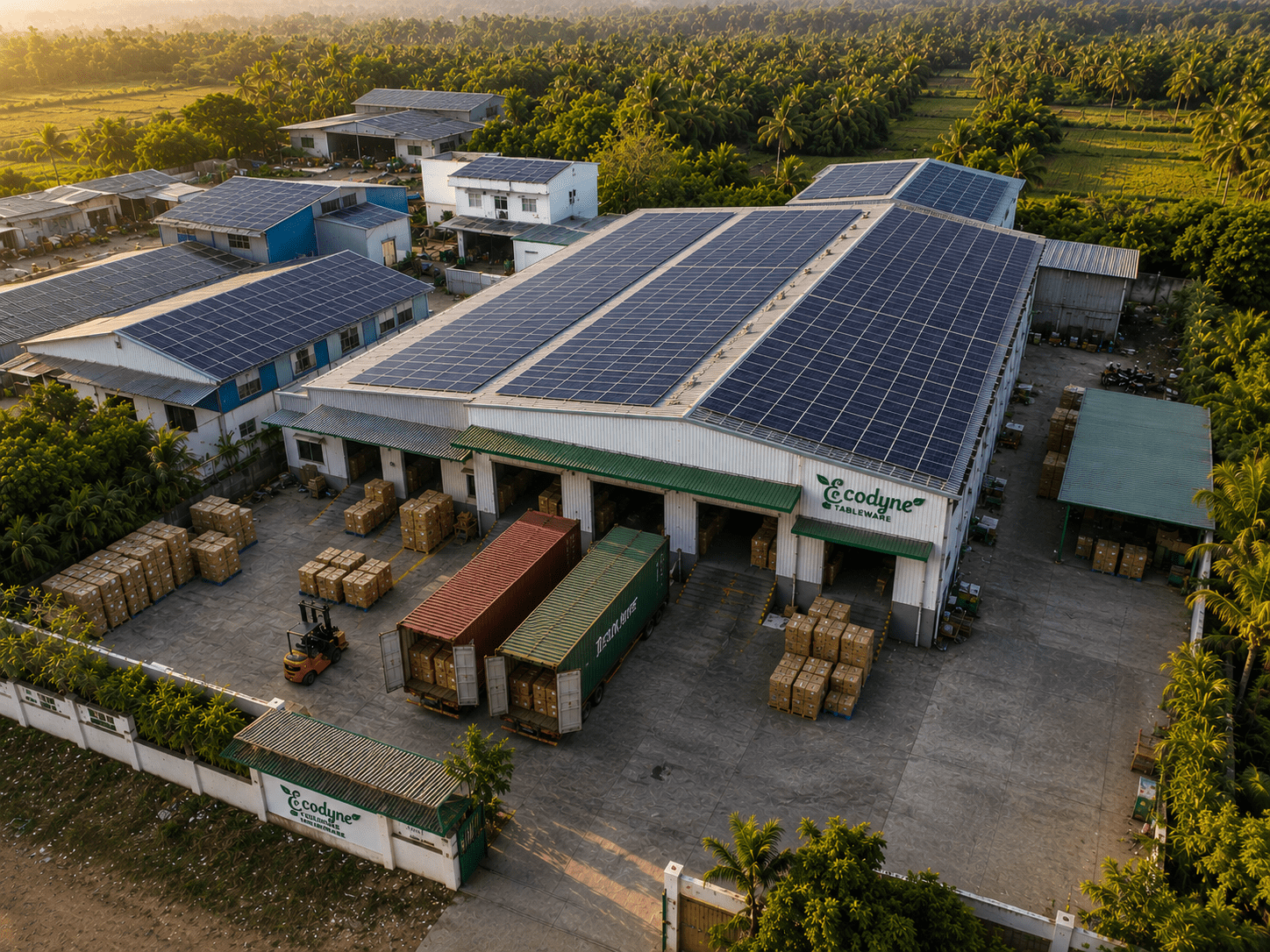
Ecodyne 200000 sq ft palm leaf tableware manufacturing plant with rooftop solar panel array
Ecodyne’s Shivamogga manufacturing hub: rooftop solar array, 90 production units, and central export container dispatch dock.

Step-by-Step Engineering

The 8-Stage Heat-Pressed Production Process

Transforming naturally fallen Areca palm sheaths into food-grade, leak-resistant tableware requires strict thermal and mechanical parameters without synthetic additives or chemical binders.

  1. Areca Sheath Collection

    Naturally shed leaf sheaths are gathered from ~810 partnered farming families across 2,000 hectares of organic cultivation. Zero trees are felled or damaged.

  2. Grading & Sorting

    Inbound raw sheaths are sorted by fiber density, sheath thickness, and natural surface clarity to determine appropriate plate or bowl SKU assignment.

  3. High-Pressure Washing

    Multi-stage potable water jets remove field dust, agricultural residues, and soil particles. Process water is routed directly to our on-site RO filtration system.

  4. Clean-Water Soaking

    Sheaths are immersed in temperature-controlled fresh water to soften tough vascular fibers, ensuring flexibility during deep hydraulic pressing without tearing.

  5. 200°C Heat Pressing

    Softened sheaths are placed into CNC-machined steel die moulds and pressed under hydraulic force at 200°C for 60–90 seconds, shaping and thermally sterilising simultaneously.

  6. 24-Hour Chamber Drying

    Pressed tableware enters a 60°C controlled-humidity industrial drying chamber for 24 hours, stabilizing moisture content below 8% to prevent warping during ocean shipping.

  7. UV Conveyor Sterilisation

    Every piece moves through a continuous UV-C radiation conveyor tunnel, eliminating surface microbes post-drying as part of our dual-sterilisation protocol.

  8. QC Inspection & Packing

    Strict manual visual check enforces a 15–17% rejection rate. Approved units are smooth-edge trimmed, vacuum-wrapped in moisture-proof polybags, and palletised.

Eco-Efficiency & Compliance

Solar Power & Closed-Loop Water Recycling

Sustainable manufacturing must be verified by measurable engineering standards, environmental controls, and transparent resource accounting.

100% Solar-Powered Operations

All 90 production units operate on rooftop photovoltaic solar electricity registered with the Karnataka Electricity Regulatory Commission. Delivering approximately 2.4 MWh per unit annually, our clean energy grid eliminates thousands of metric tons of scope-1 carbon emissions from our production footprint.

90% Closed-Loop Water Reclamation

Washing and soaking operations utilize an advanced two-stage Reverse Osmosis (RO) and UV sanitisation treatment plant. Reclaiming 90% of process water reduces municipal draw, while treated discharge strictly complies with Karnataka State Pollution Control Board environmental discharge norms.

Technical FAQ

Manufacturing & Production Queries

The process consists of: 1) Collection of naturally fallen sheaths; 2) Grading by thickness; 3) High-pressure washing; 4) Potable soaking; 5) 200°C hydraulic heat pressing; 6) 24-hour drying at 60°C; 7) UV conveyor sterilisation; and 8) Manual QC inspection and export palletisation.
Plates are pressed at 200°C in CNC-machined steel die moulds for 60 to 90 seconds. This high heat vaporises moisture inside the sheath fibers, permanently binding the natural leaf shape while sanitising the product surface without synthetic chemicals.
No. Absolutely no glues, artificial coatings, waxes, dyes, or chemical additives are used. The plates are composed entirely of pure natural leaf sheath, making them 100% bio-based, commercially compostable (EN 13432 standard PASS), and food-safe under LFGB §30/§31 parameters.
Every production line enforces a mandatory exit quality inspection. Units with pinholes, uneven thickness, natural cracks, or edge defects are removed, establishing a standard 15% to 17% factory rejection rate to guarantee that only flawless Grade-A dinnerware reaches container loading.
Standard production and loading for a 40-foot High-Cube container (approx. 300,000–350,000 pieces) is 10 working days from order confirmation. Supply agreements include a written 1%-per-day dispatch delay penalty in the buyer's favor.

Audit Integrity

Certification Standards & Industry Partners

Ecodyne's manufacturing governance is audited annually by independent certification bodies and research institutes to maintain global compliance.

Direct Factory Sourcing

Discuss Production Schedules & Container Specifications

Connect directly with our export engineering desk to request facility audit reports, standard spec sheets, or full-container loading plans.