ISO 9001 & 14001 · LFGB §30/§31[email protected]FOB New Mangalore Port, Source premium compostable plates from a trusted manufacturer. We provide eco-friendly, heavy-duty disposable tableware for global B2B wholesale. Request factory quotes & custom OEM orders now!
1. Industrial Chemistry & Compliance Architecture for CE Certified Compostable Plates
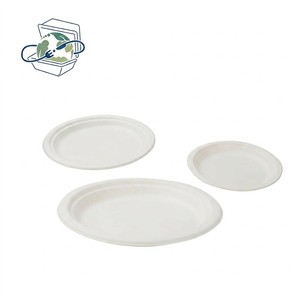
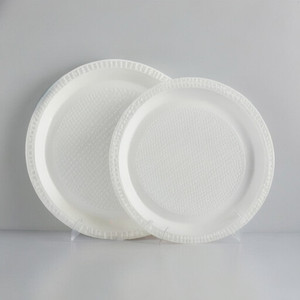
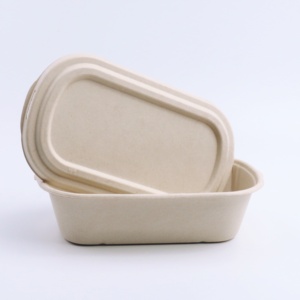
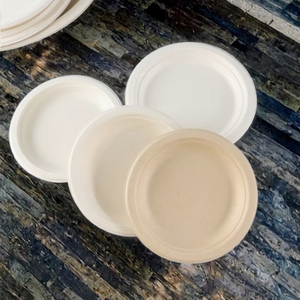
In the evolving global B2B packaging landscape, procuring CE certified compostable plates requires navigating rigorous European material safety mandates, physical performance metrics, and end-of-life environmental criteria. As primary manufacturers and OEM exporters, our manufacturing facility engineers sugarcane bagasse, cornstarch composites, and naturally harvested leaf fibers into high-performance dinnerware that bridges the gap between mechanical durability and ecological circularity.
Information Gain Insight: European Union Regulation (EC) No 1935/2004 dictates that food contact materials (FCM) must not transfer constituents into food in quantities that endanger human health. While CE marking traditionally applies to machinery and electronics, sustainable tableware sold across the European Economic Area (EEA) must adhere to Harmonized CE Environmental Standards under the Single-Use Plastics Directive (EU) 2019/904 and verified EN 13432 degradation protocols.
1.1 Fiber Matrix Engineering: Sugarcane Bagasse vs. Cornstarch Composite
Sugarcane bagasse is the fibrous residue remaining after sugar extraction. Rich in cellulose (45-55%) and hemicellulose (20-25%), our high-density pulping process refining matrix fibers to a average length of 1.2–1.7 mm. When hydrapulped and thermo-molded at 200°C under 1.5 MPa hydraulic pressure, these fibers interlock into a dense, rigid micro-network exhibiting high flexural modulus and hot-oil resistance without plastic linings.
Conversely, our cornstarch bio-polymer dinnerware utilizes thermoplastic starch (TPS) blended with biodegradable polyesters (PBAT). This yields an ultra-smooth, moisture-impervious plate ideal for saucy, cold, or greasy applications where micro-roughness must be minimized. Both material streams are formulated to be 100% fluorine-free (PFAS-free), preventing chemical migration during microwave or conventional oven heating up to 120°C.
Material Matrix
Tensile Strength (MPa)
Thermal Window
Primary Certifications
Biodegradation Rate
Thermo-Molded Sugarcane Bagasse
18.5 – 24.0 MPa
-20°C to 140°C
EN 13432, CE, LFGB §30/31, FDA
90 days (Industrial Compost)
Cornstarch TPS / PBAT Blend
14.0 – 19.5 MPa
-18°C to 90°C
ASTM D6400, CE, EU 10/2011
120 days (Industrial Compost)
Heat-Pressed Areca Sheath Fiber
28.0 – 35.0 MPa
-20°C to 200°C
USDA BioPreferred, ISO 22000
60–90 days (Home Compostable)
2. Macro Procurement & Global Sourcing Trends (2025–2030)
Institutional buyers, corporate hospitality chains, and commercial importers face accelerating regulatory shifts toward full supply chain transparency. Sourcing disposable plates is no longer just about per-unit FOB cost; it hinges on risk mitigation, regulatory compliance audit trails, and decarbonized logistics.
Zero-PFAS Global Mandates
Enforcement of total fluorine prohibitions (REACH annexes in the EU and state-level EPA laws in North America) forces suppliers to eliminate legacy fluorinated oil-repellents. Our plant-based bio-wax coatings satisfy strict oleophobic targets without PFAS.
Digital Product Passports (DPP)
By 2027, EU customs will require digital traceability for bio-based packaging imports. Our automated manufacturing logging tracks raw material batch origins, solar energy usage, and batch-level laboratory test compliance certificates.
Decarbonized Freight & Scope 3
Enterprise procurement teams actively penalize heavy carbon footprints. Operating zero-carbon solar-powered manufacturing arrays and sourcing agricultural waste within a 100km radius optimizes Scope 3 audit profiles.
3. Manufacturing Breakthroughs: Thermoforming & Quality Control
Creating high-integrity CE certified sugarcane bagasse and cornstarch plates requires stringent process parameter controls during refining, vacuum forming, heat pressing, and trimming. Slight deviations in moisture content or mold temperature lead to micro-fissures, warping, or perimeter lip instability.
3.1 The 8-Stage Precision Production Sequence
Our production lines leverage CNC hydraulic tooling operating at automated press cycles. The multi-stage quality system ensures structural consistency across multi-container shipments:
Agricultural Fiber Depithing & Washing: Residual sugars are extracted to isolate pure cellulose fibers, preventing caramelization during high-temperature pressing.
Micro-Vibration Refining: Fiber bundles undergo hydro-mechanical refining to optimize bonding surface area and fibrillation index.
Automated Vacuum Forming: Pulp slurry (0.8% consistency) is drawn onto stainless steel mesh molds using 0.09 MPa vacuum force to achieve uniform weight distribution.
200°C High-Pressure Thermo-Curing: CNC hydraulic hot-presses apply 1.5–2.0 MPa pressure at 200°C, cross-linking natural fibers and activating bio-wax hydrophobic agents.
Precision Die Edge Trimming: Laser-guided mechanical trimmers excise flash material to ensure clean, burr-free plate edges suitable for automatic denesting dispensers.
60°C Moisture Equilibration: Plates undergo controlled dehumidification to achieve a stable equilibrium moisture content of 6–8%, avoiding transit mold formation.
Camera-Assisted Automated QC Inspection: Optical sensors evaluate 100% of production for structural defects, rim warping, or color deviations before master carton packing.
Working directly with a direct factory manufacturer—rather than a trading intermediary—guarantees total cost transparency, direct engineering support, and guaranteed production scheduling. Our operational infrastructure is structured to support large-scale OEM packaging programs for global food service chains and importers.
Integrated Solar Powered Manufacturing
Our flagship production plants run on rooftop photovoltaic arrays, offsetting over 2,400 metric tons of CO2 annually. Sourcing from solar-powered production units secures lower utility overheads, translating to stable long-term pricing for commercial partners.
Guaranteed 10-Day FCL Container Dispatch
We maintain an agile stock loading protocol: standard container orders dispatch within 10 business days from confirmed artwork approval. Our commercial contracts carry a 1%-per-day late loading penalty clause written in the buyer's favor.
Private Label & OEM Molding Engineering
Currently supplying over 32 global white-label brands across 19 countries. We offer turnkey artwork adaptation, barcode integration, retail-ready shelf cartons, and rapid prototyping for custom plate geometries.
Detailed technical answers to common procurement, engineering, and logistics questions from commercial buyers.
Q1: What specific parameters validate CE compliance for compostable tableware?
CE alignment for eco-friendly tableware combines EU Regulation (EC) No 1935/2004 (Food Contact Safety), EU Regulation No 10/2011 (overall heavy metal and chemical migration limits), and EN 13432 standards for industrial compostability. Under EN 13432, products must achieve 90% disintegration within 12 weeks in a controlled composting environment and leave zero toxic or ecotoxic residues in the resulting humus.
Q2: How do your sugarcane bagasse plates achieve oil and water resistance without PFAS?
Instead of long-chain or short-chain fluorochemical coatings (PFAS/PFOS/PFOA), we incorporate proprietary bio-wax emulsions and plant-derived alkyl ketene dimers (AKD) directly into the hydrapulp slurry. During the 200°C thermoforming step, these additives cross-link with cellulose microfibers, creating a 100% fluorine-free hydrophobic and oleophobic surface barrier capable of holding 95°C water and 120°C hot oils without leakage.
Q3: What is the Minimum Order Quantity (MOQ) and container load capacity?
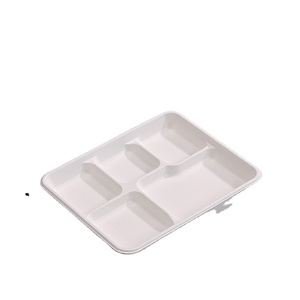
Our standard MOQ for wholesale export pricing is one 40-foot High-Cube (40ft HC) container. A 40ft HC accommodates approximately 67 cubic meters of cargo, translating to roughly 300,000 to 350,000 individual plates depending on size and rim profile configuration. We allow buyers to mix up to 4 different product SKUs (e.g., 9-inch round plates, 10-inch 3-compartment trays, and 7-inch dessert bowls) within a single container at no additional fee.
Q4: Are sugarcane bagasse and cornstarch plates safe for microwaves and conventional ovens?
Yes. Thermo-molded sugarcane bagasse plates perform exceptionally across temperature extremes, maintaining rigid structural stability from -20°C (deep freeze) up to 140°C (microwave reheating and warming ovens for up to 20 minutes). Cornstarch TPS composite plates perform ideally from -18°C up to 90°C. Neither material releases toxic off-gasses or plasticizers under high heat.
Q5: What is the shelf-life stability of these bio-plates under warehouse storage?
When stored in dry, ambient indoor warehouse conditions (relative humidity under 65%, ambient temperatures below 35°C), our sealed sugarcane bagasse and cornstarch plates possess a shelf-life exceeding 24 to 36 months without structural degradation, yellowing, or tensile strength loss. Biodegradation is triggered exclusively by active microbiological action in composting or soil environments.
Q6: Can you manufacture custom shapes, embossed logos, and specialized retail packaging?
Yes. Our engineering shop produces custom CNC aluminum thermoforming molds within 15 to 20 days. We offer custom rim embossing (such as corporate branding or geometric textures) and turnkey private label retail packaging including printed inner poly-wraps, barcode labels, and FSC-certified retail display cartons.
Request Commercial Pricing & Full Technical Dossier
Connect directly with our export engineering desk for factory-direct quotes, custom OEM container planning, and comprehensive EN 13432 / CE compliance test certificates.